Residuals and residual variation

Brian Caffo, Jeff Leek and Roger Peng
Johns Hopkins Bloomberg School of Public Health

Motivating example

diamond data set from UsingR

Data is diamond prices (Singapore dollars) and diamond weight in carats (standard measure of diamond mass, 0.2 \(g\)). To get the data use library(UsingR); data(diamond)

plot of chunk unnamed-chunk-1

Residuals

  • Model \(Y_i = \beta_0 + \beta_1 X_i + \epsilon_i\) where \(\epsilon_i \sim N(0, \sigma^2)\).
  • Observed outcome \(i\) is \(Y_i\) at predictor value \(X_i\)
  • Predicted outcome \(i\) is \(\hat Y_i\) at predictor valuve \(X_i\) is \[ \hat Y_i = \hat \beta_0 + \hat \beta_1 X_i \]
  • Residual, the between the observed and predicted outcome \[ e_i = Y_i - \hat Y_i \]
    • The vertical distance between the observed data point and the regression line
  • Least squares minimizes \(\sum_{i=1}^n e_i^2\)
  • The \(e_i\) can be thought of as estimates of the \(\epsilon_i\).

Properties of the residuals

  • \(E[e_i] = 0\).
  • If an intercept is included, \(\sum_{i=1}^n e_i = 0\)
  • If a regressor variable, \(X_i\), is included in the model \(\sum_{i=1}^n e_i X_i = 0\).
  • Residuals are useful for investigating poor model fit.
  • Positive residuals are above the line, negative residuals are below.
  • Residuals can be thought of as the outcome (\(Y\)) with the linear association of the predictor (\(X\)) removed.
  • One differentiates residual variation (variation after removing the predictor) from systematic variation (variation explained by the regression model).
  • Residual plots highlight poor model fit.

Code

data(diamond)
y <- diamond$price; x <- diamond$carat; n <- length(y)
fit <- lm(y ~ x)
e <- resid(fit)
yhat <- predict(fit)
max(abs(e -(y - yhat)))
[1] 9.486e-13
max(abs(e - (y - coef(fit)[1] - coef(fit)[2] * x)))
[1] 9.486e-13

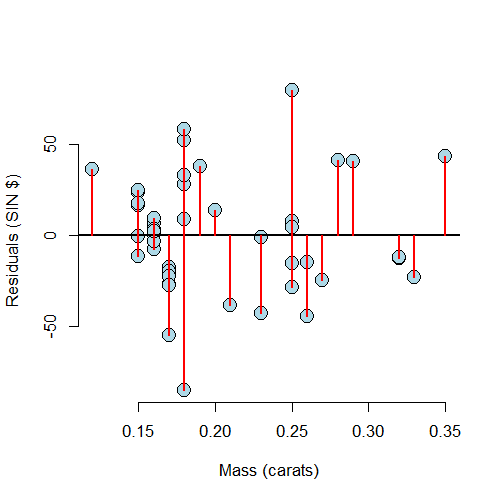
Residuals are the signed length of the red lines

plot of chunk unnamed-chunk-3

Residuals versus X

plot of chunk unnamed-chunk-4

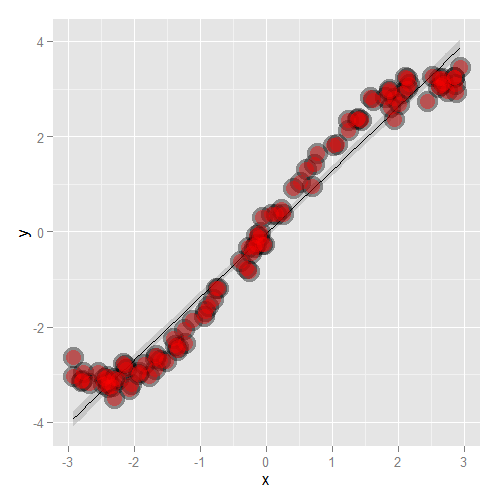
Non-linear data

plot of chunk unnamed-chunk-5

Residual plot

plot of chunk unnamed-chunk-6

Heteroskedasticity

plot of chunk unnamed-chunk-7

Getting rid of the blank space can be helpful

plot of chunk unnamed-chunk-8

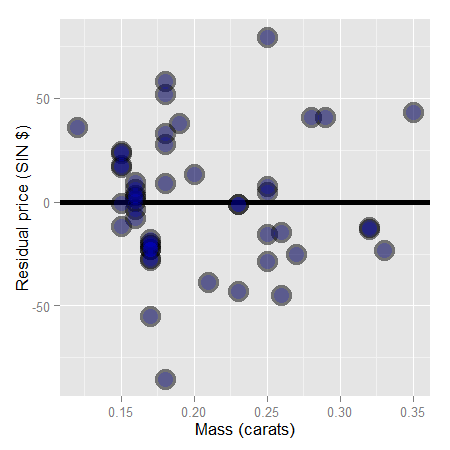
Diamond data residual plot

plot of chunk unnamed-chunk-9

Diamond data residual plot

plot of chunk unnamed-chunk-10

Estimating residual variation

  • Model \(Y_i = \beta_0 + \beta_1 X_i + \epsilon_i\) where \(\epsilon_i \sim N(0, \sigma^2)\).
  • The ML estimate of \(\sigma^2\) is \(\frac{1}{n}\sum_{i=1}^n e_i^2\), the average squared residual.
  • Most people use \[ \hat \sigma^2 = \frac{1}{n-2}\sum_{i=1}^n e_i^2. \]
  • The \(n-2\) instead of \(n\) is so that \(E[\hat \sigma^2] = \sigma^2\)

Diamond example

y <- diamond$price; x <- diamond$carat; n <- length(y)
fit <- lm(y ~ x)
summary(fit)$sigma
[1] 31.84
sqrt(sum(resid(fit)^2) / (n - 2))
[1] 31.84

Summarizing variation

  • The total variability in our response is the variability around an intercept (think mean only regression) \(\sum_{i=1}^n (Y_i - \bar Y)^2\)
  • The regression variability is the variability that is explained by adding the predictor \(\sum_{i=1}^n (\hat Y_i - \bar Y)^2\)
  • The error variability is what's leftover around the regression line \(\sum_{i=1}^n (Y_i - \hat Y_i)^2\)
  • Neat fact \[ \sum_{i=1}^n (Y_i - \bar Y)^2 = \sum_{i=1}^n (Y_i - \hat Y_i)^2 + \sum_{i=1}^n (\hat Y_i - \bar Y)^2 \]

R squared

  • R squared is the percentage of the total variability that is explained by the linear relationship with the predictor \[ R^2 = \frac{\sum_{i=1}^n (\hat Y_i - \bar Y)^2}{\sum_{i=1}^n (Y_i - \bar Y)^2} \]

Some facts about \(R^2\)

  • \(R^2\) is the percentage of variation explained by the regression model.
  • \(0 \leq R^2 \leq 1\)
  • \(R^2\) is the sample correlation squared.
  • \(R^2\) can be a misleading summary of model fit.
    • Deleting data can inflate \(R^2\).
    • (For later.) Adding terms to a regression model always increases \(R^2\).
  • Do example(anscombe) to see the following data.
    • Basically same mean and variance of X and Y.
    • Identical correlations (hence same \(R^2\) ).
    • Same linear regression relationship.

data(anscombe);example(anscombe)

plot of chunk unnamed-chunk-12

How to derive R squared (Not required!)

For those that are interested

\[ \begin{align} \sum_{i=1}^n (Y_i - \bar Y)^2 & = \sum_{i=1}^n (Y_i - \hat Y_i + \hat Y_i - \bar Y)^2 \\ & = \sum_{i=1}^n (Y_i - \hat Y_i)^2 + 2 \sum_{i=1}^n (Y_i - \hat Y_i)(\hat Y_i - \bar Y) + \sum_{i=1}^n (\hat Y_i - \bar Y)^2 \\ \end{align} \]

The relation between R squared and r

(Again not required)

Recall that \((\hat Y_i - \bar Y) = \hat \beta_1 (X_i - \bar X)\) so that \[ R^2 = \frac{\sum_{i=1}^n (\hat Y_i - \bar Y)^2}{\sum_{i=1}^n (Y_i - \bar Y)^2} = \hat \beta_1^2 \frac{\sum_{i=1}^n(X_i - \bar X)^2}{\sum_{i=1}^n (Y_i - \bar Y)^2} = Cor(Y, X)^2 \] Since, recall, \[ \hat \beta_1 = Cor(Y, X)\frac{Sd(Y)}{Sd(X)} \] So, \(R^2\) is literally \(r\) squared.